Yes, for a while, and longer than most tool vendors want to admit. Here are the four specific moments when a shared sheet stops being enough, in the order they usually hit.
The problem is not that your team doesn't write things down. It's that the one sentence explaining why a decision was made lives in a thread that scrolls away in a week.
Our build team in Lahore signs off nine hours before the client in Austin sits down to check on things. The gap only costs us money when the client's question has to wait for a person to wake up.
When the person who built it and the person who's paying for it don't agree on what 'done' means, the argument shows up on an invoice three weeks later.
Per-seat pricing looks fair until you do the math at five, eight and twelve people — then it starts explaining who gets left off the tool, and it's usually the person you most need to see the work.
When status updates go thin, the board isn't lying about small things anymore — it's lying about everything. Here's the order of operations for getting back to shared reality without adding a new layer of process.
After a missed deadline, teams write more: daily standups, longer reports, detailed minutes. It decays faster than what it replaced, and for a specific reason.
A final decision, a changed requirement, and a deployment instruction all disappear the same way in chat: they get buried under the next fifty messages. Here's how to spot them before they scroll away.
You can't take a Friday off because three people would need to text you to keep working. That's not a scheduling problem. That's the whole business running through one head.
The exit interview covers laptops and access cards. It rarely covers the fact that the only record of why a client decision was made lived in one person's head, and that head is now working somewhere else.
A good deployment handoff isn't a status update — it's the minimum information someone needs to keep going if something breaks after you log off. Here's the format that actually survives 2 a.m.
The reason most teams never adopt a project tool isn't the tool. It's the imagined weekend of copying three years of history into it before they're allowed to start.
A developer who has to guess your intent will guess in the direction that's fastest for them, not the one you meant. Here's a task structure that removes the guessing.
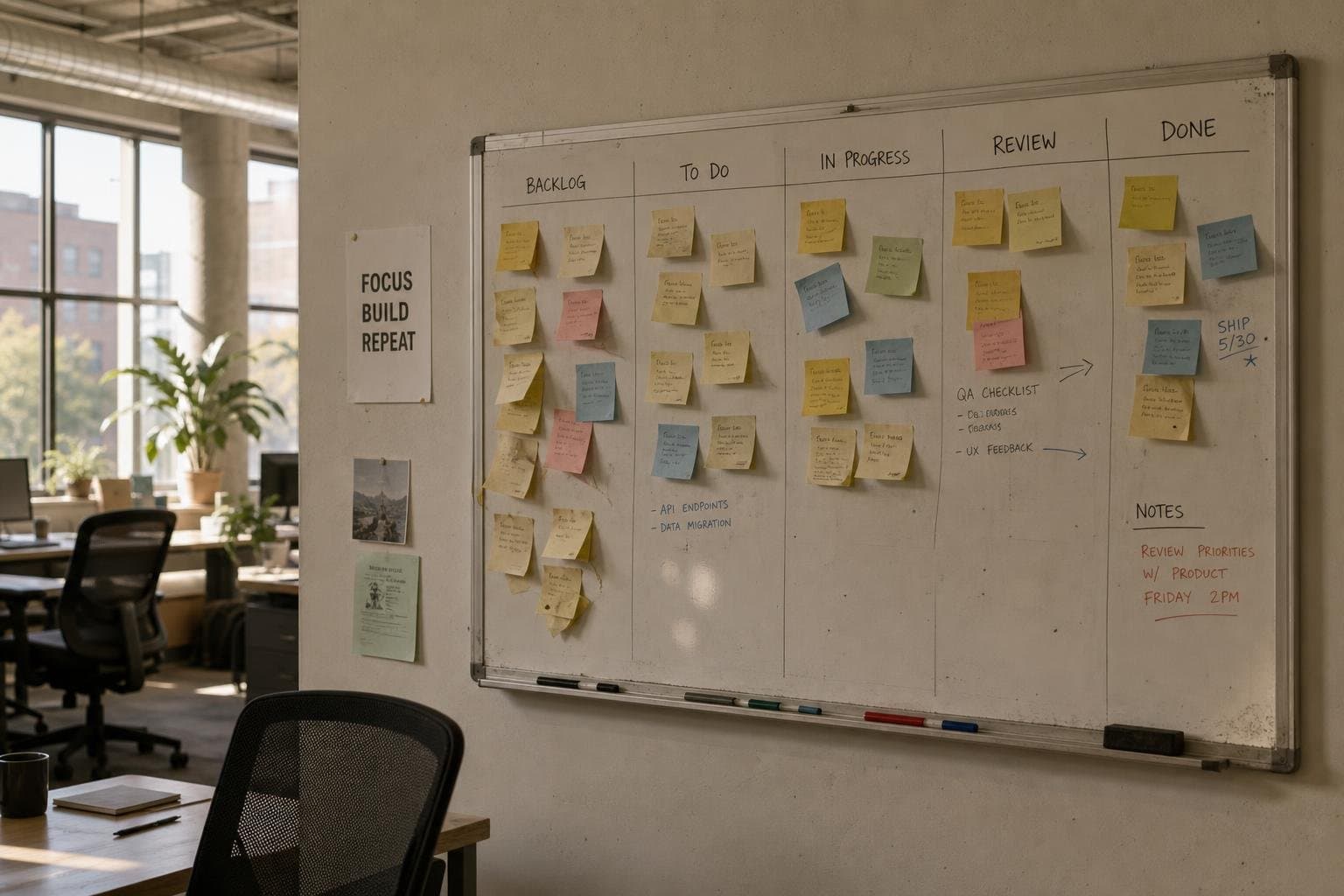
Two teams rolled out the same kind of board, watched it drift within a month, and quietly went back to asking people directly — while still paying for the software.