The Tool Is Only as Honest as Its Last Update
Two teams rolled out the same kind of board, watched it drift within a month, and quietly went back to asking people directly — while still paying for the software.

I have watched the same rollout happen four times across four different teams, with four different tools, and it ends the same way. Someone — usually the founder, sometimes the ops lead, once a client who got tired of asking for status — picks a project tool. They set it up. They write the onboarding doc. They hold the fifteen-minute walkthrough. Everyone nods.
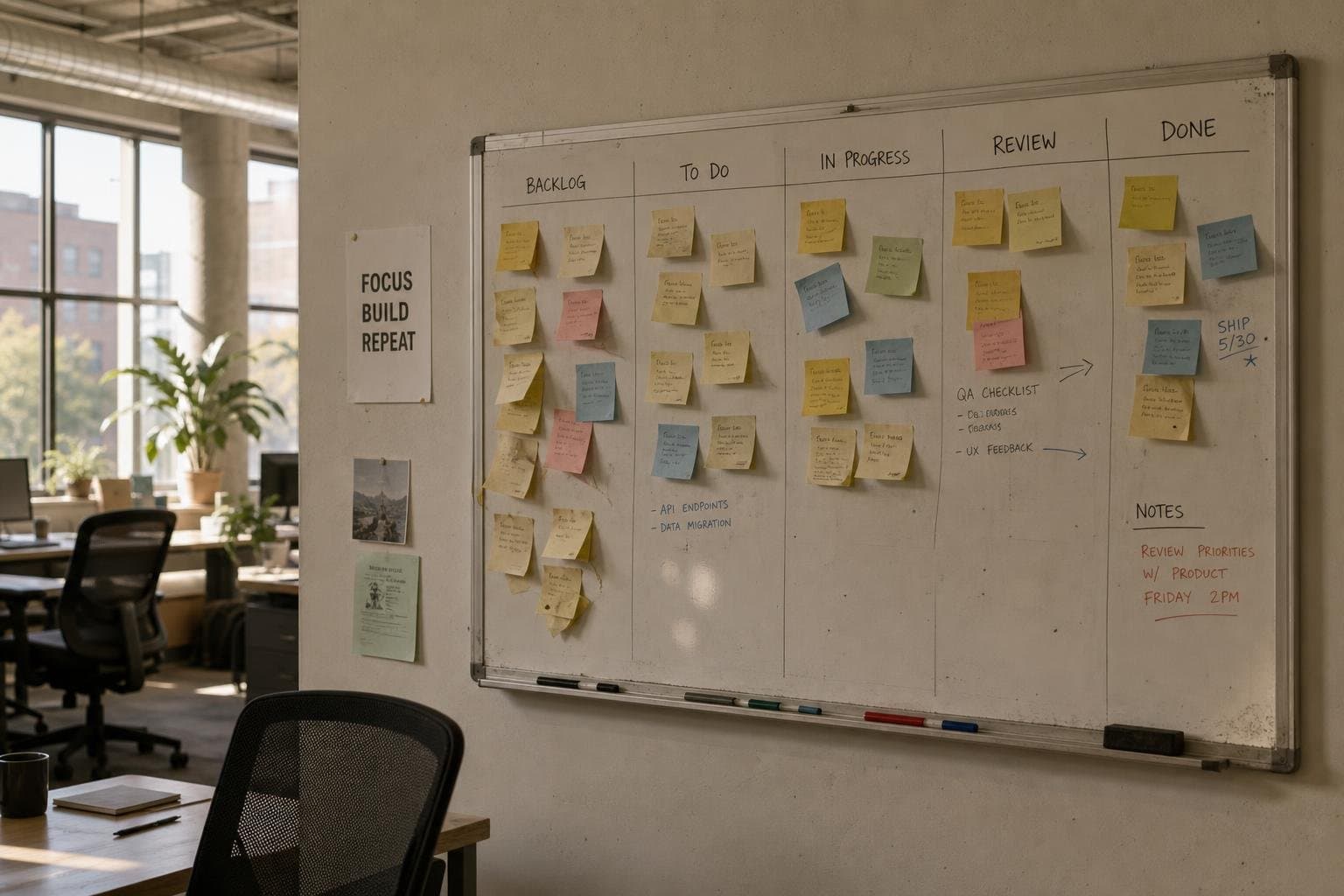
Three weeks later the board is a museum. A few cards are marked Done because someone dragged them there in the first week out of politeness. Everything after that is stale. Not because the team disliked the tool. Because keeping it current turned out to be a second job nobody was hired for.
The failure is not a training problem
Most postmortems on tool adoption blame discipline. The team wasn't consistent. Management didn't enforce it. We should have done a better job of habit-forming. I don't think that's what happened, and I've been close enough to watch it happen slowly rather than read about it after the fact.
The real failure is at the update step specifically — not the setup, not the buy-in meeting, not even the first week of good faith use. It's the moment, every single day, when a task's status has changed in reality and someone has to go open the tool, find the card, and change it to match. That step has a cost and a return. When the cost is higher than the return, for that specific person, on that specific day, they skip it. Multiply by every person, every day, and the board stops matching the work in under a month.
Scenario one: the agency that outgrew its spreadsheet, then outgrew its board too
A six-person design agency I worked alongside ran client work off a shared spreadsheet for two years. It worked, badly, until they picked up a fourth simultaneous client and the spreadsheet became unreadable. They moved to a proper board tool — columns, cards, due dates, the works — and for the first sprint it was genuinely better. Status was visible. The account lead could see what was moving without pinging anyone.
By week five, the account lead noticed she was the only one still moving cards. The two designers were doing the work, finishing it, and telling her verbally in the hallway or over a quick call, because that took ten seconds and updating the board took longer than that, plus the mental step of remembering the board existed at all. She started updating cards herself based on what people told her. That's not the team using the tool. That's one person doing double-entry bookkeeping on everyone else's behalf, which is worse than no tool, because now she's also paying a subscription for the privilege.

Scenario two: the distributed build team that moved the real conversation to chat
A different team — four engineers spread across three time zones, building a product for an external client — set up a proper board with sprints and assignees. The instinct was right: distributed teams need something durable, since you can't lean over and ask. But the tool required opening it, finding the ticket, updating status, writing a comment. The team's actual habit, formed under deadline pressure, was to fire off a message in their group chat the moment something shipped or broke, because that reached the person who needed to know in seconds, at their own local morning.
Within a month the board reflected sprint planning from three weeks prior. The actual state of the work lived entirely in a scrolling chat thread that nobody could search past yesterday. The client, who had been given board access as a transparency gesture, would ask "is this done?" and get an answer from chat, not from the tool they'd been told to check. The tool wasn't wrong. It was just never where the truth actually got recorded, because recording it there cost more than saying it out loud.

Process discipline doesn't fix a step that doesn't pay for itself
Both teams tried the standard fixes. Daily standups where someone reads status off the board out loud, so at least it gets said even if it doesn't get written. A weekly "board hygiene" half hour, which is a tell on its own — you don't need a hygiene ritual for something that's actually part of the work. A rule that no task is done until it's marked done in the tool, enforced for about two sprints before enforcement itself became the second job.
None of this is a discipline failure on the team's part. It's a design failure in the tool. If the update step requires someone to context-switch, remember a location, and perform data entry that doesn't do anything for them in that moment, you can staple all the process you want on top of it and it will still lose to the ten-second hallway conversation or the group chat message that was going to happen anyway.
“Whoever cares most about the board becomes the one asking everyone else for updates by hand — while the company keeps paying for software that was supposed to replace exactly that job.”
What we built around instead
At Team and Tricks we treat the update step as the whole design problem, not a training problem to be solved with better onboarding. The line we use is: Work without the tax. No tutorials, no setup checklist, no 'getting started' guide — just open it and start. The person doing the work shouldn't have to translate what they did into tool-shaped data entry. They tell TAI what happened — a status, a blocker, a finished checklist row — TAI prepares the change against the actual task, shows the filled-in form, and the person confirms or fixes it. That's roughly the same amount of effort as typing the update into a group chat, except it lands on the record that everyone else, including a client, can actually see.
This doesn't remove the honesty problem entirely — a team that has decided not to care about accurate status will still find ways not to update anything. What it removes is the tax specifically, the part where the update costs noticeably more than saying it out loud. Draft tasks staying quiet until they go live matters here too: half-formed plans shouldn't need anyone's attention, and shouldn't cost anyone anything to leave sitting until they're ready.
When a deadline is close or already missed, or a task has sat as a Draft, TAI follows up on its own, so the account lead in the first scenario isn't the only one who remembers the board exists.
The question worth asking before you roll anything out
Before choosing any tool, don't ask whether the team will like it in the demo. Ask what it costs, in real seconds and real attention, for the person actually doing the work to make the record match reality on a Tuesday afternoon when they're tired and the client isn't watching. If that cost is higher than just telling someone, the board will drift, and you'll be back to asking people directly within a month — paying twice, once for the software and once in the return of the job it was supposed to remove.