Why Checklist Items Need Their Own Comment Thread
Most tools treat a checklist row as a binary: checked or not. The moment a row needs a decision, an owner, or a reason it's stuck, that binary stops being honest.


Here is the orthodox move, and it is not a bad one: a checklist is a list of checkboxes. You tick them as you go. The work is binary — done or not done — and the whole point of a checklist is that it doesn't need the ceremony a real task needs. No description, no assignee, no status field. Just a line and a box.
Most project tools ship exactly that, and for a lot of checklists it's correct. A packing list doesn't need a comment thread. Nobody is going to raise a Question on "bring charger."
But run that same flat checkbox model through a QA release checklist for three sprints and watch where it breaks.
The release checklist that outgrew its own format
Picture a 40-line checklist for a release: smoke tests, migration checks, a few manual verification steps, a rollback plan line. Early on it behaves exactly like the orthodox model promises. People check boxes. The list fills up left to right. Everyone can see the release is 80% ready at a glance.
Then line 23 — "verify webhook retries against staging" — comes back ambiguous. The person running it isn't sure if the retry count they're seeing is expected or a regression. In a flat checklist, there's exactly one place for that conversation to go: the task's own comment thread, which also contains the discussion about line 7, the disagreement about line 31, and a tangent about whether line 40 even applies to this release.
Now anyone trying to find out what happened with line 23 has to read the whole thread and reconstruct which comments belong to which line. The checklist told you the state of 40 things. It did not tell you which of those 40 conversations is the one you're looking for.
This is not a formatting complaint. It's an accountability problem wearing a formatting costume. A comment thread on the parent task answers "what's being discussed about this release." It does not answer "who is responsible for line 23 being stuck, and is anyone actually blocked on it right now." Those are different questions, and a single thread can only ever answer the first one well.
What a checklist row actually needs to carry
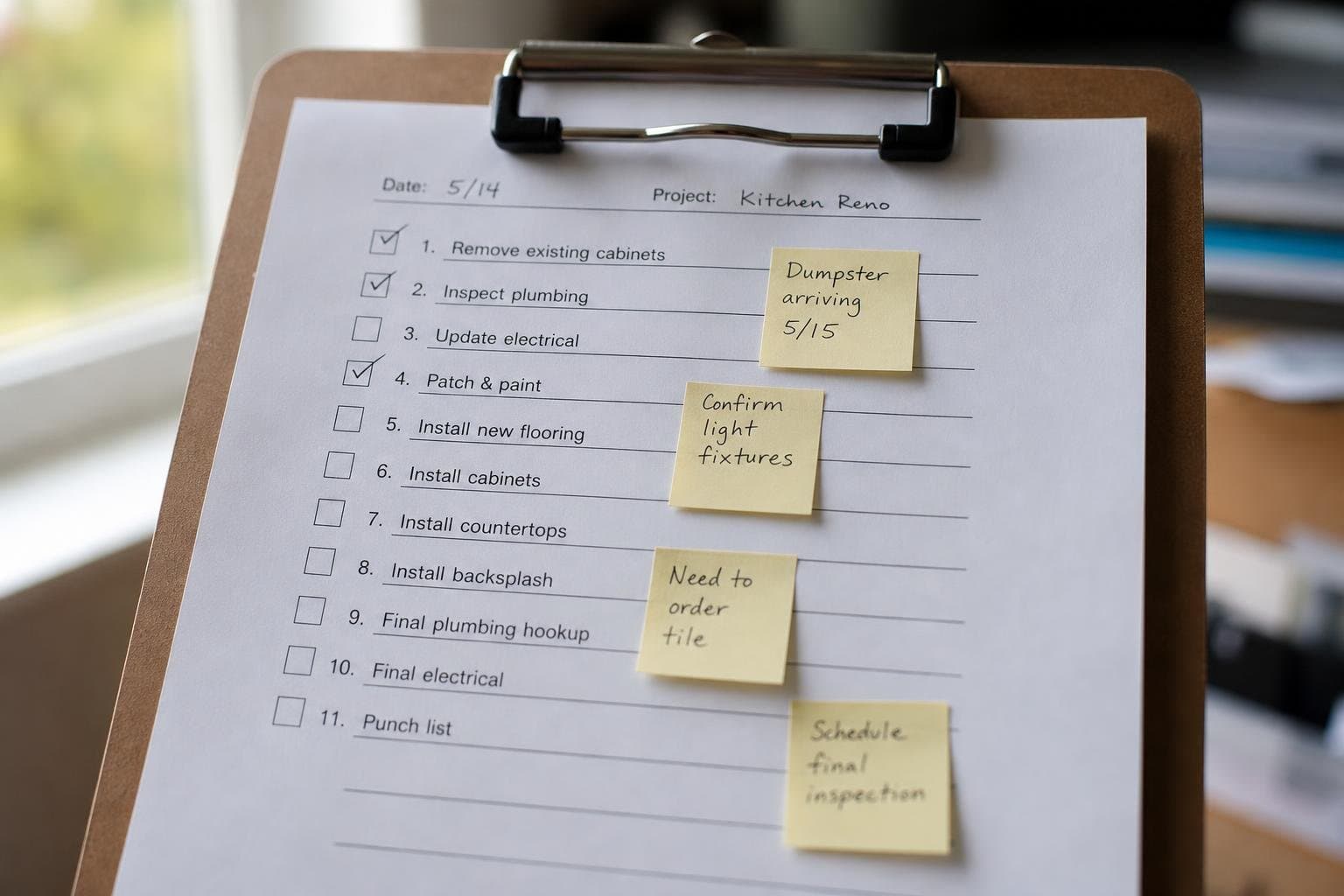
A checklist item that's genuinely trivial needs nothing more than a box. A checklist item that turns out to be load-bearing needs almost everything a small task needs, except the overhead of being one. In Team and Tricks, that's the shape checklist rows take: each row can carry its own priority, its own assignee, its own comment thread, and an attention marker — Question, Attention, or Blocked — separate from the parent task's status.
Go back to line 23 with that in place. The person running the check sets the row to Question and leaves a comment there, on that row, not in the task's general thread. Whoever's watching the release doesn't have to read forty lines of chat to find it — the row itself is flagged, and the conversation attached to it is only about that row. If it turns out line 23 is actually a regression that needs real investigation, the row gets promoted into its own Classic task with a description and a progress report, because at that point it has stopped being a checklist item and started being work.
None of this makes the checklist heavier for the 37 lines that were always fine. Those stay plain rows with a box. The cost only shows up where the work actually has a question in it — which is the only place the cost should show up.
The honest cost of refusing the flat checklist
This is where I'd like to pretend there's no tradeoff, and there is one, so I'll name it. Giving every row the capacity for a comment thread, an assignee, and an attention marker means the checklist is no longer the lightest possible object in the product. It's heavier to build, heavier to render forty of at once, and heavier to explain to someone who just wanted a packing list. If your checklist is genuinely a packing list — low-stakes, no ownership questions, nobody's job depends on line 6 — this is overkill, and you should feel free to use exactly none of it. Nobody is forced to assign a row or flag it Blocked. The box is still just a box if that's all it needs to be.
The refusal here isn't "checklists should be complicated." It's a refusal of the assumption that small work items are automatically simple work items. Size and stakes are not the same axis. A one-line checklist row can be the exact thing blocking a release, and when that happens, the tool has to be able to say so at the row, not force the question up into a thread that's also about thirty-nine other things.
The orthodox checklist is right about the common case and wrong about the case that actually costs you time: the row that turns out to matter more than its box implied. Build for the common case and you'll ship the 37 lines fine. Fail to build for the other case and you'll spend an afternoon reconstructing who said what about line 23, in a thread that was never really about line 23 at all.